


Beyond SAFe
Your organisation. Your way. Not SAFe's.
You’ve done the PI Planning. You have an RTE, an ART, maybe even a LACE. The certifications are framed on the wall. And still, your developers aren’t happy — and that nagging feeling keeps surfacing: is this really it?
If so, you are in good company — and you are asking exactly the right question.
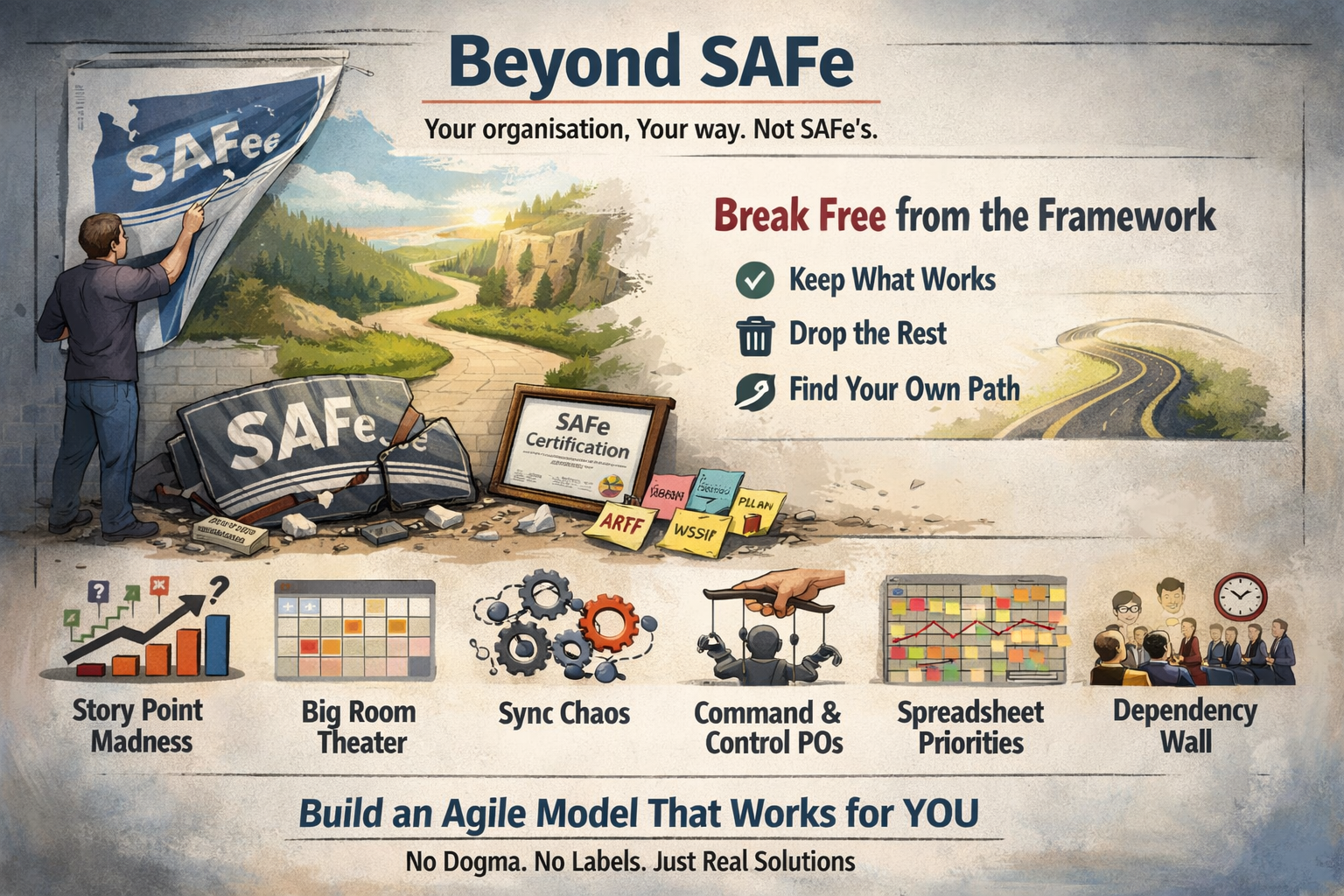

Image: ChatGPT
We know SAFe from the inside
Our consultants have been certified in SAFe. One of us even held an SPC (SAFe Program Consultant) certification at one point. We have worked with SAFe organisations of different sizes and industries. And we can count the somewhat successful implementations on one hand.
We are also well connected within the SAFe community — including SPCTs (SAFe Program Consultant Trainers) and SAFe Fellows. We know what good SAFe looks like. We have just rarely seen it.
In most cases, SAFe is — at best — a useful stepping stone. A structured way to start the conversation about agility. But the destination it points to is rarely where you actually want to end up.
Here is an uncomfortable truth: SAFe, much like RUP before it (both shaped in large part by the same people), treats agility as something you can prescribe, certify, and install. And that very premise is what limits it. The method becomes the goal. The framework becomes the product. And somewhere along the way, the organisation stops asking why.
Keep what works. Drop the rest.
Not everything in SAFe is bad. In fact, very little of it is inherently wrong. The trouble starts when good ideas become mandatory process — when understanding is replaced by compliance, and a blueprint takes the place of thinking. Some elements will bring real value to your organisation. Others you are only doing because SAFe told you to — and the cost of those is higher than it looks.
Our job is to help you tell the difference.
We are not here to sell you the next framework. Not LeSS. Not Nexus. Not a different certification programme. We are here to help you build your operating model — one that fits your organisation, that you understand deeply, and that you improve continuously. One that makes you more responsive as complexity increases. And it will keep increasing.
A small selection of patterns we’ve seen too many times
Any of these sound familiar?
Around PI Planning:
- Big Room Planning as theatre — two days, a hundred people, every Sprint slot filled to 100% before the PI has started. Nobody believes the plan. They fill in the boxes anyway. Why high utilisation is a problem rarely gets discussed in that room.
- Planning the plan — not just two days of Big Room Planning, but a six-week pre-PI planning phase before it. PMs and POs spending weeks planning to do the planning. When we first heard about this we assumed it was a joke. It wasn’t.
- The confidence vote as hostage situation — at 7 pm, after two exhausting days of planning, the department head announces: we are staying here and keep planning until everyone has a confidence of at least four. Then the hands go up. Fours and fives across the board. Well done.
- PI Objectives that surprise no one — teams list what they were already planning to do, call it aligned, and everyone goes home satisfied. Nothing changed.
- Synchronised Sprints creating bottlenecks — forcing every team onto the same cadence turns dependencies into traffic jams and coordination into an overhead industry.
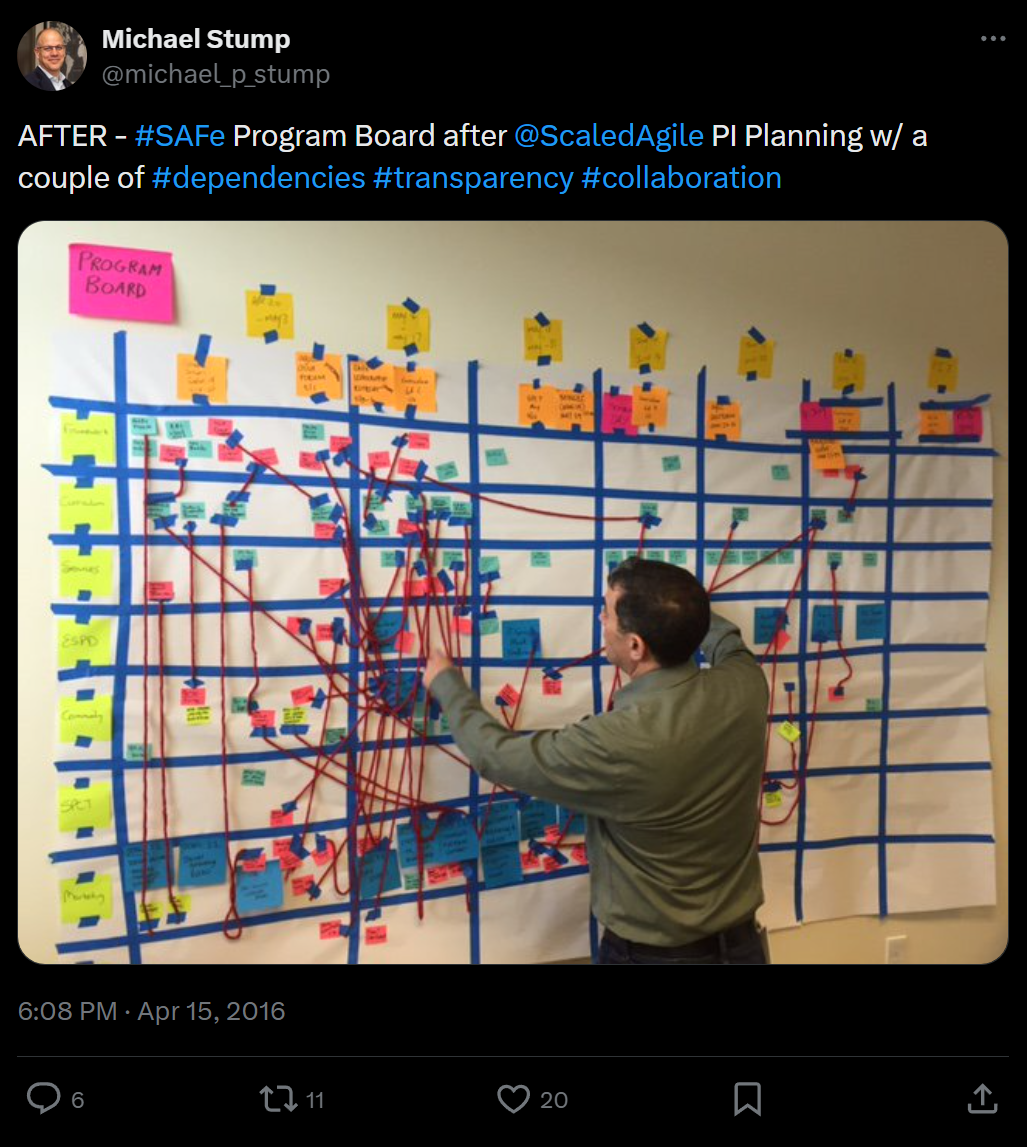
- Dependency management theatre — red string and sticky notes across a wall the size of a barn door, every dependency carefully mapped and colour-coded. And then? Nothing. No one works to actually remove or reduce those dependencies. They are managed. Documented. Accepted. The string stays up until the next PI. A classic example, described by its author as “a couple of dependencies”.
Roles and metrics:
- “Sorry Points” — story points treated as a capacity metric, compared across teams, reported upward, used in performance reviews. They are relative estimates. That’s it. The moment they become a currency, you’ve lost the plot.
- Product Administrators, not Product Owners — when managers use SAFe’s hierarchy to push pre-defined work down to POs, the role becomes a transcription service, not strategic ownership.
- RTEs wearing project manager clothes — chasing status, updating dashboards, reporting upward. That’s not a Release Train Engineer. That’s a project manager with a new title.
- WSJF as a spreadsheet sport — Weighted Shortest Job First is a sound prioritisation concept. In practice it often becomes a negotiation where teams massage the numbers to win.
- Architecture Runway as waterfall’s comeback — “Enablers” used to justify months of upfront design with no working software in sight. RUP called it phases. SAFe calls it a Runway. The smell is the same.
- Inspect & Adapt that does neither — polished slides, senior management present, no one says anything uncomfortable. Nothing adapts.
If you recognise more than two of these, the question is no longer whether to move on — it’s how.
This is where we come in
We work with organisations that are ready to be honest about what SAFe is doing for them. We help you step back, look at your current practices without the SAFe lens, and make deliberate choices about what to keep, what to change, and what to let go of. So you can take two steps — or more — forward.
1 — Assess Look honestly at what your current practices are doing for you — and what they cost you.
2 — Decide Together, identify what to keep, what to change, and what to let go of — and go beyond SAFe.
3 — Build Design your own operating model — and the discipline to keep improving it continuously.
There is no template. No unSAFe certification at the end. There is experienced, straight-talking consulting from people who have been inside SAFe organisations, seen what genuinely works, and have no interest in selling you a label.
The method must never become the goal.
Let’s have an honest conversation
Curious what agility could look like for your organisation — without the handcuffs? Reach out for a first, no-commitment conversation. Use our contact form or just drop us a line.