


Agile Transformation (Part 1): Complicated vs. Complex

By Klaus
Published on
This article was originally written in German.
Outlook
Later, in Part 2, we will look at the actual agile transformation of an organisation. First, however, I would like to lay the groundwork and establish the terminology. The concept of complexity is central to this.
Take a moment to consider what the difference is between complicated and complex. When would you say something is complicated, and when would you rather call it complex?
“Fools ignore complexity. Pragmatists suffer it. Geniuses learn to work with it.” inspired by a quote from Alan Perlis
Before we turn to the definition of complexity, let us look at an example.
The Shortest Route
Imagine you are invited to take part in a competition where the challenge is to travel the shortest distance (in metres) by car from A to B, following all traffic regulations. Let us say it is from Winterthur (north-east of Zurich) to Einsiedeln (south of Lake Zurich).
How do you prepare if you really want to win this competition?
You will probably start with Google Maps. Just as with a doctor’s appointment, a second opinion – practically free in every respect here – and a third and fourth cannot do much harm. Accordingly, Bing Maps, HERE WeGo, and whatever other map services are available will be consulted. It would also make sense to drive the routes found in advance in order to measure how long they actually are. You might even discover a shortcut that the digital helpers did not know about.
The winner is the one who draws up the best plan and thus finds the shortest route. The participants do not actually need to drive the route on the day of the competition. In fact, you do not even need a car to win.
The Fastest Route
Let us make a small change to the competition. This time the challenge is to find the fastest route.
How do you prepare now? In a similar way?
Yes and no. You would again start with maps from Google, Apple, and others — naturally, because it is so straightforward. These can also calculate the fastest routes. In theory, at least — because depending on the time of day, Google Maps, for example, will suggest different routes as the fastest. If you commit to one of these routes now — as we did in the first competition, where it served us well — then you have practically already lost, or will win only through luck, and that is not something we want to rely on.
So what do you do to maximise your chances of winning? You buy a TomTom and a Garmin sat-nav, you familiarise yourself with the “Traffic” function in Google Maps. You investigate which radio station has the best traffic reports. You might ask a friend to accompany you on race day to give you constantly updated traffic information. Perhaps they listen to a second radio channel on headphones. Perhaps you also position other friends at critical traffic points and stay in constant contact with them during the race, so that you always have the most current traffic information.
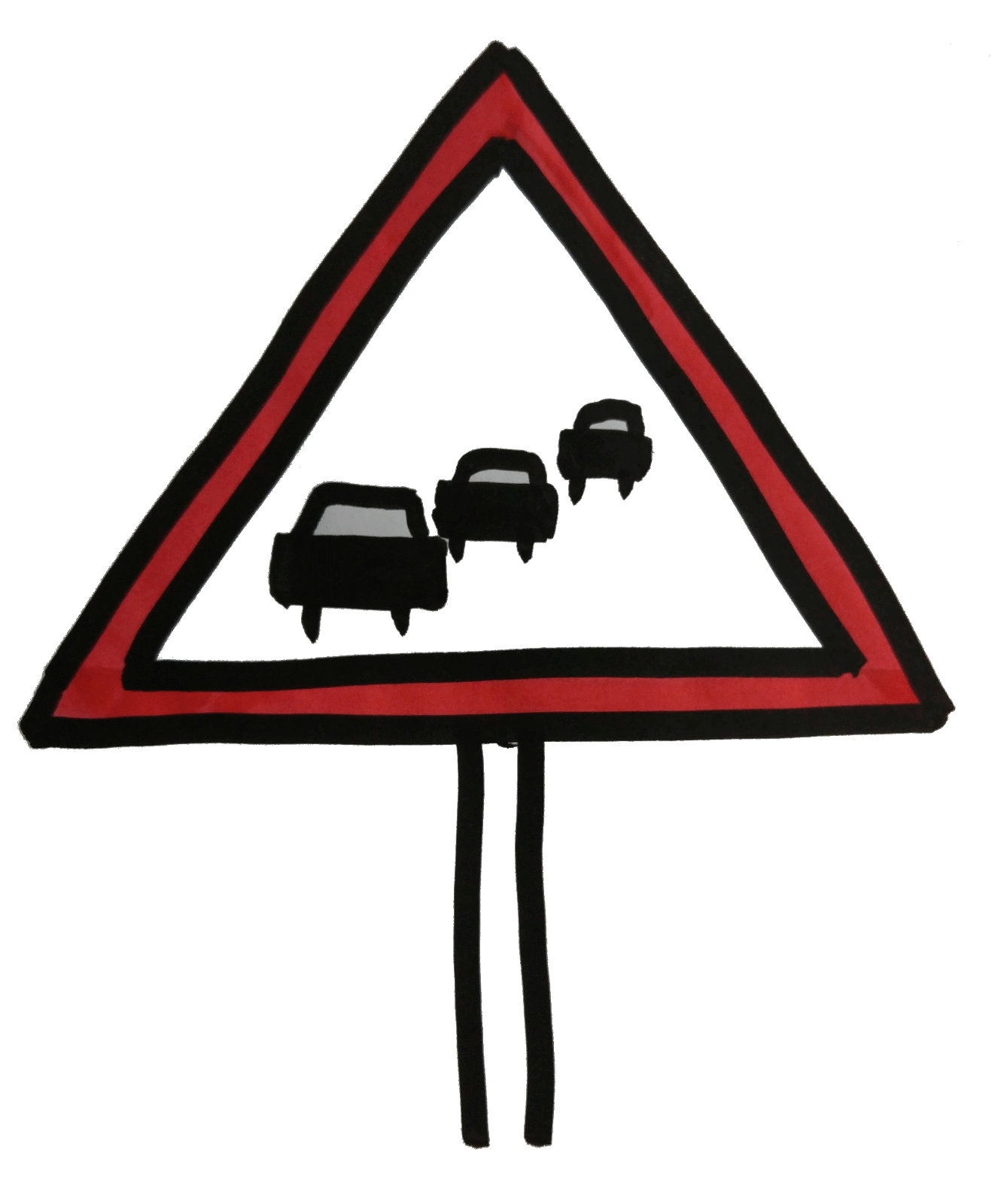 Unlike the first competition, we cannot decide on the day of the event who has drawn up the best plan and crown them the winner. We have to actually run the race. The best chances belong to the person who stays informed along the way and continuously inspects the system they are moving within, reacting to changes (black ice, increased traffic volume, accidents, etc.) as quickly as possible.
That is precisely why traffic reports on the radio exist in the first place. That is also why we are grateful to the friend driving ahead of us who calls to warn us about a traffic jam they are already stuck in, which we might still be able to go around.
We are dealing here with two — on the surface very similar — problems. Yet the approach to finding the shortest or fastest route from A to B is fundamentally different.
Complexity Defined
According to Google, “complex” means “consisting of many different and connected parts”. The “many” should not be over-interpreted, however. Even structures with relatively few but highly interconnected parts can be complex.
The first system — the problem of the shortest route — is complicated. Complicated systems are often created by humans. A watch, a car, Apollo 13 — all complicated.
The second system (the race) is a complex one. Complex because many actors in this system influence each other in unpredictable ways — if one person has an accident, or even just brakes, that may have a significant impact on everyone driving behind them. Complex systems are often close to nature or at least continuously influenced by living beings. An ecosystem, the weather, traffic — all complex.
Complicated problems are often solved most efficiently by analysing them until the underlying system is fully understood, designing the solution, planning the implementation, and allocating resources accordingly.
With complex problems, unfortunately, this does not work. No matter how much information we had at the start of the race about road conditions, all other drivers and their destinations, the weather, and everything else — regardless of how many experts and how much computing power were available to us — we cannot calculate the guaranteed fastest route in advance. We can make assumptions and develop options. What is definitively required, however, just to have the slightest chance of winning this race, is continuous inspection and adaptation. Preparations therefore also focus on making this as simple, efficient, and cost-effective as possible by creating the highest possible degree of transparency.
So What?
Why is it important to be able to distinguish between complicated and complex?
Because we are constantly confronted with different types of systems. The wrong approach, the wrong technique, is at best a waste, and at worst can lead to the complete failure of the endeavour. In particular, treating a complex system as though it were complicated can have serious consequences.
“Stop trying to change reality by attempting to eliminate complexity.” David Whyte
Why is this distinction especially important today? Because the world and our environment are becoming ever more interconnected, and thus ever more complex. It seems paradoxical that the knowledge available to us, the amount of information, and computing power are all growing exponentially, yet at the same time it seems increasingly difficult to predict the future. When analysts speak of the Fed likely raising interest rates three times this year, that is frankly laughable — nobody knows what the world will look like at the end of 2017. Everything seems possible, nothing impossible — more so than ever before.
Further Reading
If after reading this you want to delve deeper into the subject of complexity and explore other perspectives, you could look into David Snowden and his Cynefin Framework, or study one of the books by Niels Pfläging — I can particularly recommend “Organize for Complexity” and “Complexitools”.